


Beyond the Paycheck - Money, Benefits & Protection in the Live Industry for Those Working in Touring

Updated: 5 days ago
A disclaimer before we start: Everything I am sharing in this article represents my own personal views, experiences and things I have learned after decades of working professionally in the live industry. I am certainly not a financial adviser, investment professional, lawyer, CPA, or tax professional. Nothing here should be taken as financial, investment, tax, insurance or legal advice or consulting advice as we each have different circumstances. Do your own research and due diligence, speak with your accountant, tax professional and financial professionals before making any investment, retirement, insurance or business decision, and remember that rates, laws, contribution limits and tax rules change. Everyone’s financial situation is different. All content provided is for informational and educational purposes only and does not constitute professional consulting or advice. Quick note… Some links in this article may be affiliate links, which means Platinum Road may receive compensation from them. The goal while doing that is simply to share industry resources that will hopefully have as much value to you as they have for us.
What I do hope is that this article gets more people in our industry talking, thinking and asking questions about these topics.
In this Article
Why I Started Writing This | The Conversations We Need to Keep Having
Like so many of you, I care deeply about our industry and the people who have built their lives working in it. So many of us are very passionate about our business and guiding those that are entering it. Our skillsets are vast, and many of us have knowledge and experience in different areas of the business and beyond. We spend a lot of time discussing how to build better tours, advance shows more efficiently, create better experiences for our clients and those on the road, control costs, manage crews and solve the countless problems that come with putting live shows on the road. We are in the solutions industry! What I don’t think we talk about nearly enough is how the people doing the work on the road build their own financial lives around an industry that doesn’t always operate like a traditional job.

While I was starting to work on this article, I was on the phone with a good friend of mine, Dave Licursi. Dave is a highly respected tour manager & tour accountant with more than 35 years on the road. He has tour managed artists ranging from Imagine Dragons, Jonas Brothers, to Kid Rock and Hall & Oates, as well as many others. A big part of our conversation was how our industry does a great job teaching people how to do the work, but not necessarily how to manage a career built around gig work with periods of intense work followed by weeks or months without a paycheck.
Hypothetically, a tour manager may work independently, own or work for a company or work directly for talent. A production manager may operate through their own company. A technician may work for several different vendors and tours during the same year. Someone may be on payroll for one tour and a 1099 contractor on another. A touring promoter representative working for a major promoter may be a full-time or seasonal employee with a benefits package that looks completely different from the person standing next to them working directly for the talent. Some may get per diem, while others may get it at a different negotiated rate or not receive one at all. We can all be working on the same tour with different employers and have completely different financial situations. How we manage our circumstances when there really isn’t anyone discussing benefits, healthcare or other pressing issues becomes a big topic of discussion here. It by far isn’t anything new, and I do enjoy at conferences like LPS, The Conference at Lititz or Production Live when these topics come up. During the COVID shutdown, these issues became a very hot topic in countless organized discussions via Zoom, Microsoft Teams, GoToMeeting and Clubhouse, which I was proud to participate in whenever asked or invited. These conversations need to continue with action.
That conversation with Dave Licursi helped push and inspire me to write this piece. This isn’t about picking stocks or telling anyone where to invest their money. It’s really about something much simpler: We work incredibly hard for our money. Are we doing enough to make some of that money work for us and what’s out there?
The Feast-or-Famine Mindset for Those Working in Touring
Anyone who has spent enough time touring understands how quickly the financial picture can change. You can be six or twenty-six weeks into a tour with checks coming in consistently. Depending on the tour, a great deal of your work related expenses are covered while you're on the road, which may include: hotels, air and ground transportation, catering, per diem and other potential business expenses, and you’re busy enough that you may not even have much time to spend your hard earned income while the tour is going on.

Your bank balance starts climbing and yes, life feels good, even better when you’re working with a great group of individuals. Then the tour finishes a leg from the run or in entirety. Unless you have a retainer or arrangement in place, the tour income stops with that client, but your mortgage or rent doesn’t. Your car, insurance, utilities, healthcare, groceries, and everything else in normal life are still there. This is where I think the feast-or-famine mentality becomes a bigger issue for many that aren’t ready to face it.
Seeing $50,000 sitting in an account can make you feel like you have $50,000 available. For many in this scenario, you really don’t. Some of it could eventually belong to federal, state or city taxes. Some of it may need to carry you through several months when you’re between tours or if other life events come up with your income on hold. Some should probably be available for an emergency, and if you own a business, there may still be business expenses coming.
I started looking at money differently when I stopped thinking only about what was sitting in one of my accounts and started thinking about what each part of that money needed to do. How it needs to be allocated and budgeted. There is money needed now, money for taxes, money needed when I’m off the road and money I'll need available if something unexpected happens. Then there is money that I sense probably won’t be needed for a period of time. And that right there… That’s the money that started making me ask another question: Why am I letting it just sit there?
Could $10,000 Be Doing Something While You’re on Tour? CDs, Treasury Bills & Savings
Let’s use $10,000 as an example. You’re going on the road for six months and you have $10,000 that you’ve already determined you aren’t going to touch while tour income is coming in for a set time period. This isn’t your tax money or your emergency fund, it’s money that otherwise may sit untouched in an account. Safe to call it savings, though it may not be in a savings account… There are obviously many places money can go depending on someone’s situation and comfort with risk. One of the simplest things to understand, however, is a CD. At the time I was writing this article (September 2026 for reference), Charles Schwab was showing six-month brokered CDs available at rates up to approximately 4.30% APY. [1]

At roughly that rate, $10,000 for six months can generate around $213. Put $25,000 under similar circumstances and you’re around $530. At $50,000, you’re around $1,060.
Is $213 going to change your life? Of course not. But that isn’t really what caught my attention. If you had $10,000 and it was going to sit there anyway, why not look at options to make the money work a little bit for you?
There are details that matter with CDs, including when the money matures, whether there are penalties or market consequences for getting out early, what institution issued it and what insurance applies. A brokered CD can also work differently from simply walking into your bank and opening a CD. I’m not going into all of that here because I’m not trying to tell anyone what to buy and honestly, I wouldn’t say my advice is the best. The point is looking at options when I know too many in our industry don’t.
Do you remember a few years ago when Costco was selling 1oz gold bars for roughly $1,950. While writing this, those same 1oz bars are in the $4,400 range. Very good chance that when your reading this, it will be in a different range…

Yes, the market fluctuates, however, for most buying gold, they usually don’t look at it as a quick flip. Seeing the price more then double in 3 years is not a bad return… [21]
Treasury bills are another example. On September 24, 2026, the U.S. Treasury’s published coupon-equivalent rate for a 26-week Treasury bill was approximately 4.37%.[2] Again, I’m not saying go buy Treasury bills. I’m saying that someone going on a roughly six-month tour could reasonably ask their financial professional whether money they know they won’t need during that period could be doing something other than sitting in checking. That is the mindset change I’m talking about.
The Joys of Compound Interest
This is the part that really interests me. You put $10,000 towards a CD that matures in 6 months. Let’s say the six months ends and you don’t need the cash. Your accounts are healthy and instead of taking the money it earned and spending it, you put the entire amount back to work for another 6 months. Then when that matures, you do it again.
Using 4.37% simply as a hypothetical annual example, $10,000 allowed to compound at that same rate for ten years would become approximately $15,235.

If the starting amount were $50,000, the same hypothetical example would grow to approximately $76,175, more than $26,000 in growth without adding another dollar. That’s more money that you didn’t earn by advancing another show, getting on another flight, checking into another hotel or spending another day away from home. The money was working too.
The obvious disclaimer is that nobody knows what rates will look like for the next ten years. A 4.37% CD today doesn’t mean those rates will be available next year, let alone ten years from now. Rates can go up or down. The point is compounding, not 4.37%.
You can take the interest earned and spend it, and there is nothing inherently wrong with that... Or, if you don’t need it, you can let the earnings become part of the money that earns the next round of earnings. I think a lot of us understand compound interest in theory. That doesn’t necessarily mean we’re using it.
One Thing I Learned About Rolling the Money Back In
Something else worth understanding is that reinvesting doesn’t necessarily mean you avoided taxes on the interest earned. The IRS treats interest from CDs as taxable interest in most situations. Treasury bills, notes and bonds are generally subject to federal income tax, although Treasury interest is exempt from state and local income taxes. [3]
That was worth mentioning because it would be easy to think, “I didn’t take the interest out, I just rolled everything back in, so I haven’t really received anything yet.” Taxes don’t necessarily look that way.
This is exactly the type of thing I mean when I say ask the questions. Before moving money into anything, understand how it works and ask your accountant or other financial professionals how it affects you.
Pay Yourself for the Time You’re Going to Be Home From the Road
There is another part of the feast-or-famine cycle that I think can be looked at differently. If you know you’re going to be home for three months after a tour ends and before your next tour, that isn’t an emergency. You already know it’s coming and need to plan.
Hypothetically, and please look at this based on your scenario, let’s say your normal expenses at home are $7,000 a month. You already know that three months off means approximately $21,000 needs to be there at a minimum. Why wait until the tour ends to figure that out? That money can start being put aside while the checks are coming in. Perhaps you already have a CD that will mature shortly after the tour ends that you aren't planning to rollover. When you come home, you’re not randomly watching your bank account fall every month while feeling like you’re burning through savings. You already funded the time you planned to be home. In many ways, you’ve created your own off-tour paycheck.
I think the psychology of that matters too. Being home isn’t necessarily the famine period anymore. It’s a period of your career that you already paid for during the feast.
Touring Income & Taxes Shouldn’t Be the Surprise at the End of the Year
This is another obvious one that still catches people. If you’re receiving any 1099 income, seeing the money hit your account doesn’t mean every dollar belongs to you.

If you aren’t using a payroll service, I think separating tax money as you’re earning it can make an enormous difference. Once it’s moved into an account specifically for taxes, stop looking at it as money available to spend.
Depending on how you’re paid and how your business is structured, payroll withholding and estimated tax payments may also make sense. Using a payroll service that automates withholding and payments can take a lot of guesswork out, however as I’ve mentioned, everyone’s situation is different.
Someone working in multiple states, receiving W-2 income from some companies and 1099 income from others, or operating an S corporation can have a very different tax situation from someone working one job in one state. I’m not attempting to explain anybody’s tax situation here. I’m saying it may be in your best interest not to wait until March or April to find out what happened.
Your business structure can also be worth revisiting as circumstances change. Where you live, how your income is earned, where the business operates and what filings or expenses are required can all affect whether the structure you have still makes the most sense. An S corporation, LLC or other structure may provide different tax, payroll or retirement-planning opportunities depending on the situation, but that is a conversation to have with your accountant or financial advisor based on the business you actually have, or don’t have, today.
Know What You Actually Made | Your Real Walkaway

There is a reason we settle shows, and it’s truly one of my favorite parts of the business. We don’t look at the net box office receipts, subtract a few expenses from memory and decide it looks close enough. We reconcile everything with backup. I think our own businesses deserve the same attention.
I used QuickBooks for my bookkeeping and payroll for many years. After learning more about Xero from my accountant and how easy I found it to be, I made the switch. Xero allows me the ability to stay organized for my accountant and organize my books as well for my bookkeeper. The codes we added for categorizing properly work for me, and when I’m not sure how my accountant may want something categorized, I have a code for ‘Ask My Accountant’.

As I mentioned, there are some affiliate links in the article, like Xero, though I'm glad to mention that one added benefit right now is that new customers signing up through my Xero link receive 80% off their first six months with no coupon code needed.[25]
For payroll, I now use Gusto, and the integration between Xero and Gusto makes that side of the business easy for me as well. It was very easy to get comfortable using it, and I really liked what Gusto offered. Xero expanded that relationship earlier this year by launching Xero Payroll powered by Gusto in the United States. [4]
Whether it’s Xero, Gusto, Quickbooks Online & Payroll, or so many of the other platforms or services out there, what matters is having something you’re actually going to use and also talking with your accountant about what will work best for them. When money is coming in, I want to know what has been earned, what has gone out, what still needs to be reconciled and what the business really looks like. I don’t want to wait until my accountant is preparing a return to find out how the year went.
For someone who hates doing payroll and/or reconciliation themselves, there are bookkeepers who can handle it. Many others I know in our industry also love working with Cast & Crew or Entertainment Partners for payroll and again the key is doing your diligence. The goal isn’t to become a bookkeeper. The goal is to know your numbers. Even though I do my own expense reconciliations, I have my bookkeeper go thru my books quarterly, including bank statements. I always await a few questions which usually revolve around how I have certain business expenses coded or something that may be off.
If You Own an S Corporation, Are You Using the Benefits Available to You?
I own and operate an S corporation, so this is something I have paid more attention to over the years. Having a corporation shouldn’t only mean that Platinum Road gets paid, pays its expenses, accounts payable and then pays me and all others on payroll. I want the company to be organized and I want to understand what advantages may be available through having a business.
Payroll is one piece of that. Using Gusto as my company solution means payroll and payroll taxes can be handled without me having to manually calculate everything every time I pay myself. The tax payments are submitted as well. But what I think is easy to overlook is that a payroll platform can offer more than payroll.
Gusto, for example, offers benefits administration, including retirement options, and specifically says an owner-only business can establish a Solo 401(k). Its owner-focused, which also offers those using it access to certain health, dental and vision benefits. [5]
That is the type of thing I want someone reading this to stop and think about. If you own your own company, are you giving yourself access to any of the benefits you might expect if you worked for somebody else’s company?

The Part About a Solo 401(k) and S Corporation That Opened My Eyes
I’m purposely going to keep this simple because this is where it becomes very easy for someone who isn’t a financial professional to start sounding like one. I’m clearly not, though I play one on TV… Yes, I’m trying to be funny…
What interested me was learning that with an S corporation and the right retirement plan, there can potentially be money going into the retirement account from two sides. There is what you contribute as the employee (even if you are the business owner), and there can also be contributions from your company as the employer (and again, even if you are the business owner). The IRS specifically recognizes salary deferrals from the employee as well as matching or other employer contributions based on W-2 compensation. [6]
Think about that during a big year. You already know you’re going to make considerably more than you expected. Bonus yourself or think long term??? Rather than waiting until after the year ends and saying, “I probably should have done something with some of that money,” why wouldn’t you call your accountant or financial professional while the money is still coming in? Talk to them about this.
Could I be putting more into retirement? Can my company contribute? Is there a tax advantage to having the company make a contribution? How does what I’m taking as salary versus distributions affect what I can do? Those are questions you should be asking if you aren't already, not recommendations.
The company contribution was particularly interesting to me, and this is where the numbers started to get my attention.
For 2026, the IRS allows total contributions to a defined-contribution plan, including employee and employer contributions, of up to $72,000, depending on compensation, the plan and other applicable rules. For someone age 50 or older who is eligible for the standard catch-up contribution, that number can potentially reach $80,000. For those ages 60 through 63, the higher catch-up provision can potentially bring the total to $83,250. [7] [8] That is very different from simply hearing that the employee 401(k) limit is $24,500.
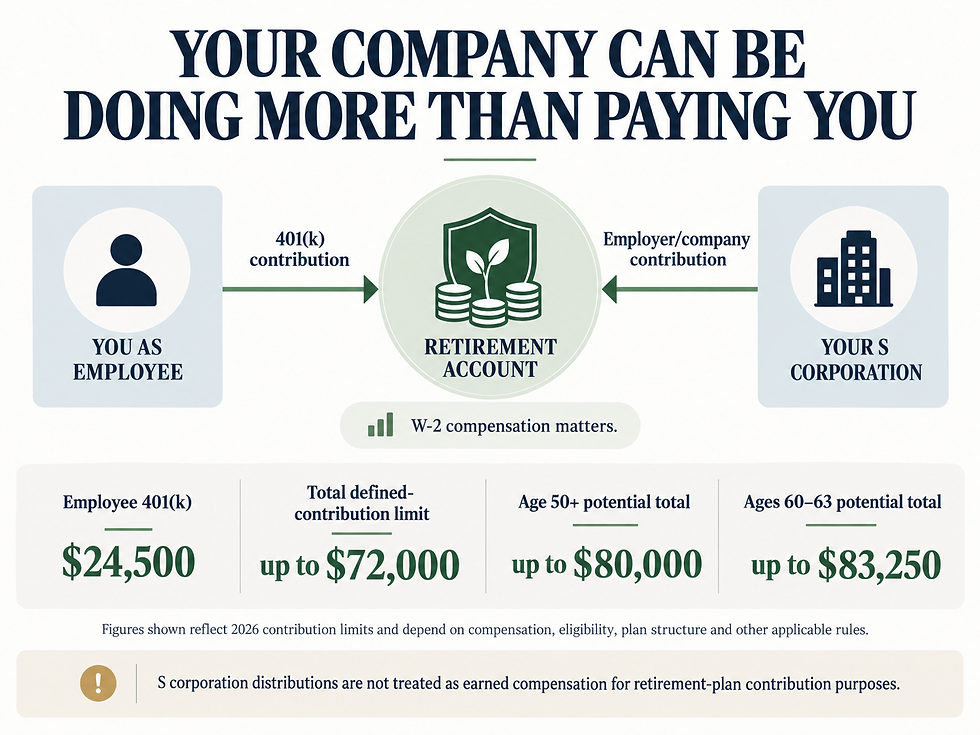
If you own an S corporation and have a strong year, there may be an opportunity for you to contribute through payroll while the company makes an additional employer contribution. The IRS confirms that an S corporation can make matching or other employer contributions based on the employee-owner's W-2 compensation. Employer contributions to a qualified plan can also generally be deductible to the company within applicable limits. [6] [7]
I would be careful calling that money “tax-free.” A better way to look at it is tax-advantaged. With a traditional 401(k), eligible contributions can go into the retirement account without being taxed to you as ordinary income at that time, and the money can continue growing tax-deferred until it is eventually withdrawn. Taxes generally come later... The company's eligible contribution can also create a deduction for the business. [7]
Think about the power of that during a much larger earning year. Instead of only asking what you're going to take in salary or distributions, it may be worth asking your accountant whether part of a strong year can be used to make a meaningful company contribution towards your retirement. Depending on your compensation and circumstances, the conversation may not be about putting another $5,000 away. The numbers can potentially be many times that.
I bring up the catch-up provision for the same reason I bring up so much of this: ask your accountant and see what they suggest for your situation. Retirement may feel a long way off or it may already be something you're thinking about seriously. Either way, knowing what options are available to you now, and what additional opportunities may become available later, can change the way you think about the money you're earning today. Once catch-up provisions become available, they can allow additional money to be put away on top of the normal contribution limits, which can make that conversation even more meaningful.
There is also an important distinction with S corporation distributions. The IRS does not treat shareholder distributions as earned income for retirement-plan contribution purposes. W-2 compensation is what matters when determining the employee and employer contributions available through the plan.[6] That is another reason you may want your accountant involved before simply deciding how much to take as a salary, how much to take as a distribution and what the company may be able to contribute towards retirement.
Again, I am not going to tell anyone how much salary they should take or what they should do with distributions. My reaction was much simpler: I own an S corporation. This is something I need to understand and discuss with the people advising me. If you own one too, maybe you should ask the same question.
Solo 401(k), IRA or SEP IRA: They Aren’t the Same Thing
This is another place where it’s easy to lump retirement into one category. A 401(k) is generally a retirement plan sponsored through an employer or business. An IRA is an Individual Retirement Arrangement that you establish individually, and it has its own contribution limits and tax rules. For 2026, the standard IRA contribution limit is $7,500, with an additional $1,100 catch-up contribution for those age 50 and older. [9]
I’m not going deeper into traditional IRA versus Roth IRA versus SEP IRA versus Solo 401(k) here. A SEP IRA is another option worth at least knowing exists, particularly for someone who is self-employed or owns a small business. For 2026, employer SEP contributions can generally be up to the lesser of 25% of eligible compensation or $72,000, although the calculation and rules can be different for someone who is self-employed. [24] I’m not suggesting one retirement plan over another, but it’s another reason to ask what structure makes the most sense for how you actually earn your income. That’s exactly where I want someone qualified advising me and you should want the same.
Here's a fun visual breaking out how a 401(k) and an IRA aren't the same thing based on what you already read. I figured it may be easier to see it this way as well:

What I do think people should know is that the options exist, and if you’re earning good money and haven’t discussed retirement with anybody in years, or have been putting it off, it may be worth starting that discussion.
What If You Work for a Bigger Company?
This article isn’t only for independent contractors or people who own businesses. There are many touring professionals working for promoters, production companies, vendors, venues and major entertainment corporations. Depending on your employment classification, you may have access to benefits that someone working directly for talent doesn’t have.
A touring representative employed by a major corporation could have group or employer-provided health insurance, a company 401(k), employer matching, life insurance, disability coverage and other benefits that someone earning a higher (or lower) weekly rate directly from a tour has to provide for themselves. That matters when comparing compensation.
If you work for a larger company, I think it’s worth having a real conversation with HR about the complete benefits package available to you rather than assuming you know what’s there. A 401(k), employer match, life insurance, disability coverage, an HSA or other benefits all have monetary value, and the weekly rate or salary isn’t always the entire compensation package.
Health Insurance for Touring Professionals Has a Different Meaning When Your Office Changes Every Day
I had a friend recently tell me that with what premiums are these days, it feels more and more like we have a 'for-profit' healthcare industry rather than a healthcare system that works for everyone... Health insurance is absolutely another area where our industry is different and its tough to stomach each year when rates go up and the challenge of which plan to take becomes a reality for many. Most people buy health insurance based largely around where they live. We may live in Nevada and work in New York on Thursday, Pennsylvania on Friday, Texas and Oklahoma the following week and continue bouncing city to city in the weeks after that.
That makes the provider network incredibly important. Marketplace insurance isn’t all the same and I’ll be the first to say, I truly loathe the pain our industry experiences when it comes to medical insurance. HealthCare.gov explains that some plan types, including many HMOs and EPOs, generally restrict non-emergency coverage to providers within the plan’s network. PPOs (if offered) may provide some out-of-network access, usually at a higher cost. [10]
There are also plans sold directly by insurance companies outside the Marketplace. Some are ACA compliant, while other types of coverage can come with more restrictions, including limitations involving pre-existing conditions or reduced benefits. If you’re looking outside the exchange, it’s worth understanding exactly what you’re buying and how the plan works before assuming it provides the same protections. [20]
For many people, in-state insurance purchased through the exchange does not necessarily translate into in-network care once they are outside that state. Yes, you heard me correctly if you didn’t know this… Depending on the plan, coverage outside the home state may be limited to urgent care or emergency room visits, while routine doctor visits, specialists, diagnostic services and other non-emergency care may be treated as out of network or may not be covered at all. That can be a major issue for touring professionals who may spend much of the year working far from where their insurance was purchased.
So if you’re touring, one of the questions shouldn’t only be, “How much is my premium?”

It should also be, “What happens when I need a doctor 2,000 miles from home?”
Emergency care has federal protections even when the hospital is out of network, but routine care, specialists and other services can be a different story depending on the plan.[10] That is something I think touring professionals should pay much more attention to when comparing plans.
Another thing worth asking about when looking at health insurance is whether the plan makes you eligible for a Health Savings Account (HSA). If eligible, contributions to an HSA can provide a federal tax deduction, the money can grow tax-free and withdrawals used for qualified medical expenses can also be tax-free. For 2026, the contribution limit is $4,400 for self-only coverage and $8,750 for family coverage.[23] Again, it’s one more tool that may be sitting there that someone simply hasn’t asked about.
Health Insurance May Cover Treatment. What About Getting You Home?
There is another service I think people in touring should at least know exists, and one I don’t leave home without: Medjet.
Medjet is not health insurance or travel medical insurance. It is a medical transport membership program. If a member of Medjet is hospitalized as an inpatient 150 miles or more from home, MedjetAssist can arrange medical transportation to a hospital of the member's choice in their home country for continued inpatient care. One of the things that caught my attention is that the transport does not have to be considered “medically necessary” simply because the hospital you're currently in is capable of treating you. [14]
Think about that in terms of what we do for a living. You're on the other side of the country, or the other side of the world, something serious happens and you're hospitalized. Your health insurance may be dealing with the medical bills, but that doesn't necessarily answer another question: How do I get back to my doctors, my family and the hospital I actually want to be in? How do I get home where I know I’m seeing in-network doctors and won't have to possibly deal with the pain that comes from seeing denial letters from insurance… I'm not necessarily saying that Medjet covers everything as we’re all too familiar with fine print and limitations, though I do always feel better having my annual coverage of the MedjetHorizon plan with them when touring.
Medjet has short-term memberships for 8, 15, 21 or 30 days, annual memberships, collegiate plans, domestic-only options and longer Expat180 and Expat365 memberships for people spending extended periods outside their home country. MedjetAssist focuses on medical transport, while MedjetHorizon adds security and crisis-response services, which makes me feel better having it on international tours in markets where security is on the top of mind. [14]
The cost of medical transport is also why I think this is worth having in your toolkit if you don’t already. In one member story published by Medjet, a member suffered a ruptured appendix while traveling in New Zealand. Medjet says the medical transport back to her hospital at home cost $185,000, while the member paid nothing beyond the cost of her membership for the transport.[15] That's obviously one person's experience and not a promise of what every situation will look like, but it certainly puts the potential value of medical transport into perspective.
Affiliate Ad

There was another example on Medjet's site that immediately got my attention because it involved our industry. A New York production company was in South Korea for a major concert when political tensions increased. The company had MedjetHorizon, which includes security and crisis-response services in addition to the medical transport benefits. [16]
That is a real-world scenario that doesn't feel very far removed from touring. I have been in markets overseas where there have been protest marches down the streets in front of venues and/or hotels which have gone violent, and the only thought is making sure everyone gets out in one piece. It's not something you hope to ever use, but if something happens that requires it, you won't regret it! When the US struck Iranian nuclear facilities in 2025 and I had a show in Abu Dhabi that wasn't canceled, I was very glad to have Medjet coverage in place. Fortunately airspace was open and tensions calmed down while flying out a few hours after the show ended, where I didn't need to contact them, though the peace of mind I had by having the coverage was everything.
I would encourage anyone interested to read Medjet's actual membership rules and compare the different options rather than assuming every membership works the same way. There are requirements and limitations, including the hospitalization requirement for medical transport. The point of bringing it up here is that I think this is one of those resources a lot of people in our industry may simply not know exists and it’s not cost prohibitive.
International Touring: Don't Assume Your Health Insurance Travels With You
International touring brings another layer into the health-insurance conversation. Before leaving the country, I think it is always worth understanding exactly what your normal health insurance will and will not cover once you're overseas and then looking at international travel medical coverage to fill the appropriate gaps. There isn’t an international tour I’ve done where I haven’t grabbed a plan as life does happen, and yes I have been hospitalized and have needed medication overseas multiple times.
For international travel, in recent years I have usually purchased IMG's Patriot Platinum travel medical coverage as I just like what it offers. IMG itself offers a number of different plans depending on the trip, coverage level and traveler. Patriot Platinum is IMG's higher-level short-term travel medical option. I like it because it includes deductibles starting at $0, medical maximums that can reach $8 million depending on the option selected, telehealth, emergency medical evacuation and other international medical benefits. Coverage can be priced by the day or month depending on the trip.[17]
One thing I also noticed is that Patriot Platinum offers an optional Trip Cancellation, Interruption & Travel Delay Rider. That can matter if an illness or other covered event changes the trip itself, not just the medical care. If something happens that forces the trip to change or be extended, having that additional coverage could become just as important as the medical coverage itself.[17] It's another reason I think it's important to look beyond just the medical maximum and actually read what the plan includes and what options are available.
What I like is being able to look at the dates I'm traveling, where I'm going and the coverage I want rather than assuming my health insurance is going to take care of anything abroad, which it may not. IMG also has other options. For people traveling internationally multiple times during the year there is a Patriot Multi-Trip plan that can cover repeated trips of 30, 60 or 90 days under an annual plan.[18] For a touring professional doing several international runs in a year, that is another option available instead of purchasing separate coverage every time.
There are group options as well, which is something I think business managers and management teams should pay attention to. IMG offers group travel-medical plans and an annual Multi-Trip Group plan for qualifying groups traveling internationally.[19]
Affiliate Ad

I've worked on tours where the business manager covered the cost of international medical coverage for traveling personnel. I've also had international travel medical coverage treated as a business travel expense through my own company, so if international touring is in your future, it’s another important item to be aware of. How any individual or company handles that expense should obviously be discussed with their accountant, but I think providing appropriate international medical coverage is a reasonable conversation to have when we're already spending considerable money moving people around the world for work. And yes, there are others out there and maybe your carrier offers international options, I just have used IMG as my main go-to for my international travel coverage….
And this is where IMG and Medjet should not be confused with one another. IMG is designed to help with eligible medical expenses and other covered benefits while traveling. Medjet is a membership designed around arranging medical transport home when its requirements are met, while MedjetHorizon adds security and crisis-response services for members as well. One doesn't automatically replace the other. For me, that's exactly why both are worth knowing about.
Options are always worth looking at. For anyone with an international tour coming up who wants to compare what else may be available, Squaremouth is another resource worth knowing about. It allows you to compare options from multiple carriers side by side, including plans with travel medical coverage and other travel-related benefits.
If you're going or putting somebody on a plane to another country for work, it’s worth looking at. I’m so used to someone always getting sick at the beginning of a run and/or needing to see a doctor at some point… And yes, sometimes it’s us…
Affiliate Ad
Touring Crew Benefits: Something Business Managers and Management Teams Should Think About for Touring Personnel
There is another side of the health-insurance conversation. If you’re a business manager, management company or employer already putting touring personnel through payroll, have you looked at what benefits those you’re putting on payroll as employees could potentially have access to?
One thing worth recognizing is that when we work in union venues, health and welfare contributions for local labor are often already built into the collective bargaining agreement. Those employees have a structure in place providing contributions toward benefits. Touring personnel, however, are often in a very different position. Unless they work for an employer providing benefits or have negotiated some type of medical stipend or contribution, the cost of health coverage is typically something they are handling on their own. That difference is worth acknowledging when we talk about the true cost of working on the road. It's no surprise to anyone that the cost of quality healthcare tied in with the cost of living has not been getting cheaper, which only makes that difference more meaningful for touring personnel who may be covering the entire cost themselves.
I’m not suggesting that every tour can suddenly offer a large corporate benefits package. There are costs, eligibility requirements, carrier rules and other considerations. However, if an organization has multiple employees and group coverage is available, perhaps there is an opportunity for eligible touring personnel to participate. PPO coverage through a group plan vs individual on-exchange plan can go a long way on the road… More importantly, look at the actual network being offered. A plan that works wonderfully for an employee who goes to the same office every morning can look alot different for somebody spending 200 nights a year away from home. Maybe your group plan has a broad national network. Maybe it doesn’t. That is worth knowing and discussing.

There are current efforts within the touring industry looking at this issue directly. Concert Touring Crew Benefits is a grassroots initiative working with IATSE around healthcare and retirement benefits specifically for touring crew.[22] This is not an endorsement of the program or suggesting it will fit everyone, as I can’t say I know enough about it or have spoken to others that are using this, but it is a current industry conversation that touring professionals, employers and business managers may want to be aware of.
Even giving someone the opportunity to buy into an available group plan could be meaningful if that plan fits their life better than what they can purchase individually. When employment ends, there may also be decisions involving COBRA or Marketplace coverage. Losing qualifying job-based insurance can create a Special Enrollment Period for Marketplace coverage, while COBRA may allow someone to continue the employer plan for a period of time, usually at a considerably different cost once the employer is no longer contributing toward the premium. [11]
This is another area where I think information itself has value. Someone coming off a tour has enough to think about. Health insurance shouldn’t become a problem they discover after coverage has already ended.
This Is Also Why Rachael Bronstein of Life’s Jam Is Part of This Conversation
The more I worked on this article, the more obvious it became that this isn’t only about interest rates, payroll systems and retirement accounts. There is a behavioral side to feast-or-famine income.
An industry friend, Rachael Bronstein founded Life’s Jam specifically around financial coaching for touring crews and music industry professionals. Her work deals with many of the things I’m talking about here, including unpredictable income, taxes, debt, savings and building financial stability between gigs. [12]
I wanted Rachael’s perspective in this article before I considered this piece finished in a collaborative way. Often when I work with attorneys, someone will bring up, it’s not what’s in the contract (or rider), but what’s not in it that needs to be there. And yes, Rachael is not an attorney, however I particularly like her thoughts… It’s my way of advocating her services to other tour managers, production managers, and business managers that aren’t aware of what her company offers. I particularly wanted her perspective on why somebody can have a great year and still find themselves financially stressed when the tour ends, and which habits make the biggest difference when someone’s income naturally comes in waves.
One of the biggest challenges with touring income isn't simply how much someone earns. It's what happens when that money starts coming in.
Spending gives us an immediate reward. Saving for three months from now doesn't usually create the same feeling. Add in life on the road with long days, little sleep, being away from home, missing family and friends, and spending can easily become a way to reward ourselves or make life feel a little better. We may spend more when we're tired or stressed, send extra money home because we're missing things, or look at a growing bank balance and feel like there's plenty available because another paycheck is coming next week.
That's why I like to work with touring professionals before or during rehearsals, while the run is just getting started. Rather than trying to restrict spending, we create a plan for the money before it arrives. I use a simple three-bucket framework called Fixed, Flex and Future to help people understand what needs to support life now, what they can comfortably spend, and what needs to be protected for things like taxes, time off between gigs and longer-term goals.
The goal isn't to have to track every dollar in an app or spreadsheet. It's to build a system that gives you enough information to make intentional choices. Money is a tool. When you know what your money needs to do, you can use it to support the life you actually want to live, both on the road and off.
Rachael Bronstein | Life's Jam
I have my own thoughts from living it and systems that work for me within my business structure, though I also know the way I track and manage things may be more detailed than what works for someone else. That doesn't mean every system is perfect or that there isn't always something that can be improved, but having structure in place gives me visibility and has made a meaningful difference for me in making better decisions. Through Life’s Jam, Rachael works with people dealing with these issues directly. She works with people just like many of you that are reading this! If some of what we’re talking about here feels familiar, Life’s Jam is absolutely a resource worth knowing about and a conversation worth having. That’s an example of what I hope this article becomes: not me trying to come off as someone having all the answers, as I definitely don't, but people within and around our industry bringing different experiences to the same conversation. It only allows each one of us to better position ourselves for success.
Sometimes You Need an Actual Person | Another Resource
Technology isn’t everybody’s thing, and neither is trying to figure all of this out yourself. If somebody would rather sit down or talk on the phone with a professional and go over areas such as life insurance, financial protection or longer-term planning, there are people who understand what earning a living in entertainment actually looks like.
My friend Eric Kagan, a financial services professional licensed to assist with Life Insurance, Long Term Care, Investments, Annuities, and Rollovers based in Southern California, is one of those people I’m comfortable mentioning. Eric spent decades working in the entertainment industry before moving into financial services. His public FINRA employment history shows 20 years with IATSE Local 44 before joining New York Life and NYLIFE Securities. [13]
Whether you talk with Eric, Rachael, a family friend that is knowledgeable about finance or any other person mentioned in this article or the topics at hand, I can only recommend one thing... Do your own due diligence, talk to different people, verify credentials and make sure whoever you’re working with understands your circumstances and is the right fit for you.
The recommendation is really about something broader: find professionals who understand how you actually make a living and want to help you. Someone working in touring may earn heavily for seven months, make very little for two months, work for six different companies, receive W-2s and 1099s, own a business and work in dozens of states during the same year. That’s not an unusual situation in our industry, and the people advising us should understand that. Talk to other tour managers, production managers, colleagues, tour personnel and ask questions.
Questions I Wish More of Us Working in Touring Were Asking

There are a lot of things I didn’t think about earlier in my career, and I doubt I’m alone. One conversation with my accountant led to looking at whether my business structure still made sense after being out of California for several years.
That discussion alone eliminated an additional corporate filing in the years ahead, the California franchise tax and certain city filings and business expenses that were previously required. The corporate conversion was also much easier than I anticipated. It was another reminder that circumstances change, and sometimes the questions worth asking aren’t obvious until you sit down with somebody who understands your business and take action.
I feel strongly some of the questions worth asking are:
If you’re having one of the strongest earning years of your career, have you called your accountant before December and asked whether there is anything you should be doing differently?
If you own an S corporation or LLC, have you asked what benefits your own company could provide for you beyond issuing a paycheck?
If you have money sitting in an account that you know you’re not going to touch for six to twelve months, have you looked at whether it could safely be earning something or explored options?
If your employer offers a retirement plan, are you using it, and if there is an employer match, do you understand how it works?
If you’re over 50, do you know whether catch-up contributions are available to you?
If you’re working for a major entertainment company, have you ever asked HR to walk you through the benefits available under your employment classification or if/when you qualify?
If you’re buying your own health insurance, have you actually asked about coverage outside your home market and what it looks like if you are injured or sick while on the road out of state or the country?
If you’re a business manager or part of the management team employing touring personnel, have you looked at what benefits you could potentially make available to the people spending months away from home supporting your client? If nothing, have you discussed a medical coverage stipend or contribution?
Again, the purpose of this article isn’t to overwhelm or to say there’s a right or wrong way to do payroll, medical, finances or any of the other various topics mentioned. It’s to add dialogue to some very important issues that many of you reading this deal with every day.
Making Your Money Work for You
None of this means every dollar has to be invested. Enjoy your money. Go on vacation, buy something you worked hard for, take time off, have a great dinner and splurge once in a while. We work incredibly hard in this business, and there is nothing wrong with enjoying what comes from that work. I’m sure for many, it also becomes a challenge to think about investing.
The difference though that I’m hoping to convey is being intentional. Spending $2,000 on something you really want is one decision. Having $2,000 disappear over six months without really knowing where it went is another.
Our industry is built around logistics on the highest level. We book dates and route tours months in advance, book hotels, flights, ground transport, buses, advance shows, hire staffing, work with local labor, settle shows nightly and do it over again night after night. We can move enormous productions across countries and have them ready to do the same thing from market to market, day after day.

We are very good at going over all the logistics involved when it comes to the show. Feast or famine, investing, being organized as a business, payroll, medical coverage and protection... Let’s keep talking about these topics and focus on being solution oriented wherever possible…
The more I worked on this article, the more I realized there isn’t one answer pretty much to any one topic discussed, and there shouldn’t be. Someone working for a major promoter has a different financial structure from a tour manager. A production manager with an S corporation may have different opportunities from a technician working through a vendor. Someone in their twenties or thirties should probably be asking different questions then someone in their fifties or sixties.
What I think is clearly identifiable is the issue itself. A large part of our industry operates around irregular income, gig work and periods of very high earnings followed by periods when the work stops. At the same time, many of the people working in it have been left to figure out taxes, benefits, retirement, insurance and long-term financial planning largely on their own.
I’d like to hear from touring professionals, business managers, management teams, accountants, financial professionals, promoters, employers and people who have dealt with the same issue from another angle. That includes people who have found something that worked for them and people who wish somebody had explained something to them 20+ years ago.
This isn’t about me or Platinum Road having the answers. It’s about recognizing identifiable issues within our industry and having more communication around them. If sharing experiences, asking better questions and bringing knowledgeable people into the conversation can eventually help us find better solutions, that’s a conversation worth continuing.
We spend our careers looking out for the show and looking out for one another on the road. Maybe we can do a little more of that when it comes to our financial lives as well and have these discussions off the road with others that can relate or help.
Affiliate Ad:

Sources and Further Reading
1. Charles Schwab, Certificate of Deposit Rates
Supports the September 2026 example showing six-month brokered CDs up to approximately 4.30% APY.
2. U.S. Department of the Treasury, Daily Treasury Bill Rates
Supports the September 24, 2026 26-week Treasury bill coupon-equivalent rate of 4.37%. Treasury’s official table shows 4.37% for the 26-week coupon-equivalent rate on that date.
3. Internal Revenue Service, Publication 550: Investment Income and Expenses
Internal Revenue Service. Publication 550: Investment Income and Expenses. Covers the federal tax treatment of interest income, including interest from certificates of deposit, Treasury bills, notes and bonds, and explains that Treasury interest is generally exempt from state and local income taxes.
Xero’s August 2026 announcement regarding its U.S. payroll integration with Gusto.
Information regarding retirement and benefits administration, including Gusto’s owner-only 401(k) availability and benefits offered through Gusto Solo.
6. Internal Revenue Service, Retirement Plan FAQs Regarding Contributions, S Corporation
IRS guidance explaining employee salary deferrals, employer contributions and why S corporation shareholder distributions are not treated as earned compensation for retirement-plan contribution purposes.
7. Internal Revenue Service, Retirement Topics – 401(k) and Profit-Sharing Plan Contribution Limits
IRS information regarding the tax treatment and deductibility of eligible employer retirement-plan contributions.
8. Internal Revenue Service, 2026 401(k) and Catch-Up Contribution Limits
Official 2026 contribution limits, including the standard employee deferral and applicable catch-up amounts.
9. Internal Revenue Service, 2026 Retirement Plan Cost-of-Living Adjustments
Official 2026 IRA contribution and catch-up limits.
10. HealthCare.gov, Health Insurance Plan and Network Types | Getting Emergency Care
Federal information explaining HMO, EPO and PPO network differences and protections involving emergency out-of-network care.
11. HealthCare.gov, Getting Health Coverage Outside Open Enrollment
Information regarding loss of job-based coverage, COBRA and Marketplace Special Enrollment Periods.
12. Life’s Jam, Rachael Bronstein
Information regarding Rachael Bronstein’s work providing financial coaching and financial-wellness programs for touring crews and music-industry professionals.
13. FINRA BrokerCheck, Eric S. Kagan
Public employment history documenting Eric Kagan’s entertainment-industry background with IATSE Local 44 and subsequent work with New York Life and NYLIFE Securities.
14. Medjet, Membership Rules & Plan Information
Membership rules, 150+ miles from home, inpatient requirement, hospital of choice, MedjetAssist vs. MedjetHorizon, membership types.
15. Medjet, Member story
New Zealand ruptured appendix / $185,000 transport example
16. Medjet, Case study
New York production company in South Korea – MedjetHorizon security response example
17. IMG, Patriot Platinum
Deductibles, medical maximums, telehealth, evacuation, pricing.
18. IMG, Patriot Multi-Trip
Annual plan with 30/60/90 day trip duration options.
Information regarding annual multi-trip travel coverage.
20. Healthcare.gov, Private Plans Outside the Marketplace | Pre-Existing Condition Protections
Information regarding health plans sold directly by insurers outside the Marketplace, qualifying coverage, Marketplace savings limitations and protections involving pre-existing conditions.
21. Costco, Gold Bar Pricing | Current Gold Market Pricing
Published information documenting Costco’s 1oz gold bars selling for approximately $1,950 in 2023, along with current market pricing for gold.
22. Concert Touring Crew Benefits, CTC Benefits initiative with IATSE
Information about the Concert Touring Crew Benefits initiative and its work with IATSE around portable healthcare and retirement benefits for touring professionals.
23. Internal Revenue Service, Health Savings Accounts (HSA) | 2026 contribution Limits
IRS information regarding HSA eligibility, tax treatment and 2026 contribution limits of $4,400 for self-only coverage and $8,750 for family coverage.
24. Internal Revenue Service, SEP Contribution Limits
IRS guidance regarding SEP IRA contribution limits, including the 2026 limit of the lesser of 25% of eligible compensation or $72,000.
25. Xero, Affiliate Referral Offer
Affiliate offer available through Platinum Road's Xero referral link as of October 2026. Xero website states Offer expires March 31, 2027, though information should be independently verified. New-customer promotional offers, eligibility, terms and availability are subject to change.


Comments